Executing GLP BSL-3 Studies: Supporting Vaccine and Antiviral Clinical Trials Through Reliable Virus-Related Clinical Sample Testing
As infectious disease programs advance from early discovery into meaningful efficacy evaluation, sponsors often reach a critical inflection point: determining when a study must move from BSL-2 into a BSL-3 environment—and selecting the right partner to support that transition.
At Southern Research, BSL-3 studies are not treated as a standalone capability, but as an integrated extension of the organization’s long-standing infectious disease, vaccine, and antiviral development expertise. With decades of experience, rigorous GLP compliance, and the ability to support both preclinical and clinical workflows under high containment, Southern Research provides sponsors with clarity, confidence, and continuity at one of the most complex stages of development.
What Defines a BSL-3 Study—and Why It Matters
Biosafety Level 3 (BSL-3) containment is required for work involving pathogens that can cause serious or potentially lethal disease via inhalation or other routes of exposure. These include certain neurotropic viruses, encephalitic viruses, and high-consequence pathogens that cannot be safely handled under BSL-2 conditions.
Examples include alphaviruses such as Venezuelan equine encephalitis virus (VEEV), orthopoxviruses like monkeypox (used as a surrogate model for smallpox), and select bacterial agents historically studied under BSL-3 containment. In many cases, human challenge studies are unethical or impossible, leaving animal models as the only viable path to demonstrate efficacy.
In these scenarios, regulatory agencies—including the FDA—may allow product approval under the FDA Animal Rule, provided efficacy, immunogenicity, and safety are demonstrated in validated animal models under appropriate containment and quality systems.
A Rare Combination: BSL-3 and GLP Compliance
Running a BSL-3 study is demanding on its own. Executing those studies under full Good Laboratory Practice (GLP) conditions is significantly more complex—and far less common.
Southern Research is among a small group of organizations capable of conducting GLP-compliant BSL-3 studies, including:
- In vivo challenge studies in non-human primates and other relevant species
- Immunogenicity and efficacy assessments for vaccines, antibodies, and antivirals
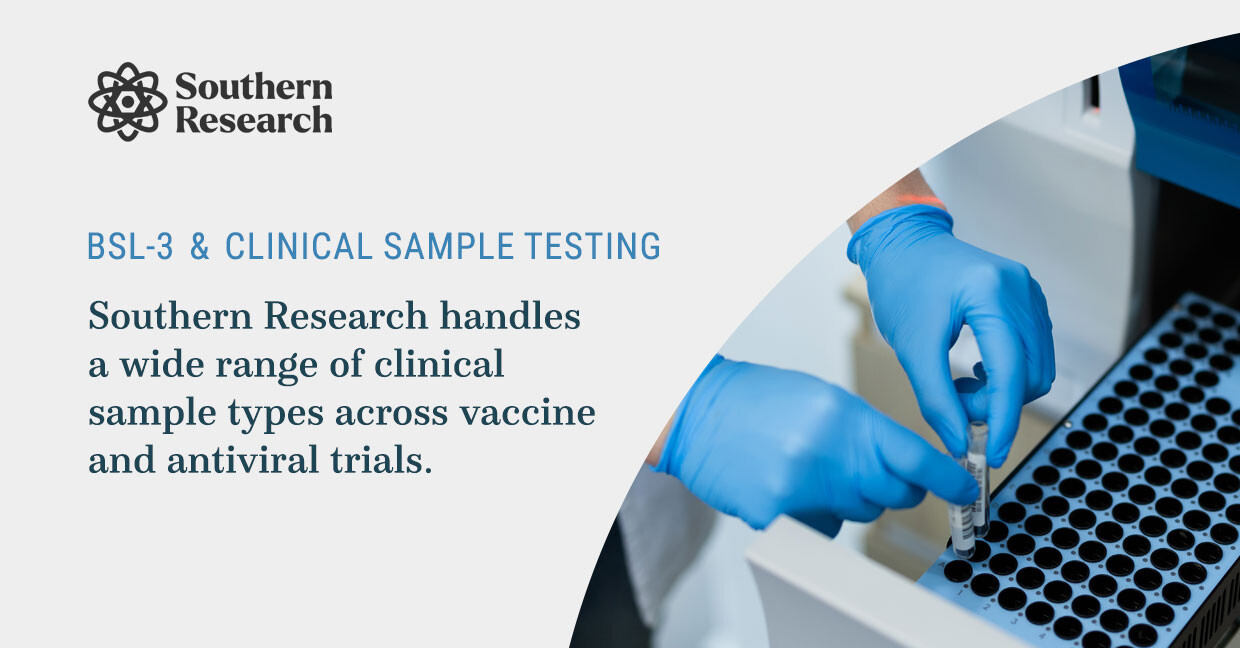
- Clinical and preclinical sample testing under high containment
This capability requires extensive infrastructure, highly trained and vaccinated staff, dedicated SOPs, and continuous audit readiness. Southern Research’s BSL-3 operations are routinely inspected by the CDC, supported by specialized safety leadership, and backed by systems that track and manage BSL-3 samples with precision—including recent expansion of LIMS capabilities into high-containment workflows.
Why Wild-Type Virus Studies Matter
While replicon systems and attenuated models can sometimes be used under BSL-2 conditions, they are not always scientifically equivalent to wild-type viruses. RNA viruses in particular may behave differently in surrogate systems, requiring additional validation to confirm relevance.
Southern Research’s ability to work directly with wild-type, live viruses under BSL-3 containment allows sponsors to generate data that more closely reflects real-world circulating strains—reducing uncertainty and strengthening regulatory confidence. For many sponsors, this scientific fidelity is a key driver for choosing a BSL-3 partner.
When and Why Programs Transition from BSL-2 to BSL-3
A common area of confusion for sponsors is understanding when a study truly requires BSL-3 containment. Using vaccine development as an example, programs often begin under BSL-2 during the vaccination or immunization phase, when no live challenge virus is involved.
The transition to BSL-3 typically occurs when sponsors move into the challenge phase, where animals are exposed to the target pathogen to assess efficacy. This is the point at which containment requirements—and study complexity—change significantly.
Southern Research works closely with sponsors to plan this transition intentionally, ensuring that study design, timelines, and regulatory expectations are aligned well before animals enter the BSL-3 environment.
Strategic Guidance That Reduces Risk and Cost
BSL-3 studies are resource-intensive, and missteps early in planning can lead to delays and unnecessary cost. Southern Research’s teams routinely help sponsors avoid these pitfalls through proactive consultation.
In some cases, this means recommending a phased approach—starting with proof-of-concept efficacy studies using BSL-2 strains before expanding into larger, more expensive BSL-3 programs. This maturation strategy allows sponsors to generate meaningful data while managing risk and budget responsibly.
Just as important is operational readiness. Items such as test article availability, formulation stability, and shipping timelines can become bottlenecks if not addressed early. Because BSL-3 facilities operate on tightly coordinated schedules—particularly for influenza and other pathogens that cannot be run concurrently—alignment between sponsor and study team is essential.
Southern Research assigns a full, dedicated study team upon contract execution, including a study director, project manager, study coordinator, and business development support, to keep programs on track and ensure transparency around cost drivers and scheduling realities.
Scale, Experience, and Engagement Under High Containment
One of the most distinctive aspects of Southern Research’s BSL-3 capability is scale. The organization has demonstrated the ability to conduct large, GLP-compliant NHP studies—handling dozens of animals under BSL-3 conditions [FK1] while maintaining data quality, safety, and sponsor engagement.
Equally important is the level of scientific interaction. Sponsors consistently cite Southern Research’s highly engaged study directors and technical teams as a differentiator, particularly in complex infectious disease programs where real-time decision-making and communication matter.
Bridging Preclinical and Clinical BSL-3 Testing Under GCLP
Perhaps Southern Research’s most compelling advantage is its ability to support both preclinical and clinical BSL-3 activities within the same organization. Sponsors often struggle to find partners that can execute animal studies under BSL-3 while also performing clinical human sample testing using the same assay platforms.
By maintaining continuity across species and development stages, Southern Research enables true apples-to-apples data comparisons—simplifying data interpretation, strengthening translational relevance, and easing the transition into first-in-human studies.
A Partner for High-Consequence Programs
BSL-3 studies are not routine—and they shouldn’t be treated that way. They demand experience, infrastructure, scientific judgment, and operational discipline.
Southern Research brings all of those elements together, offering sponsors not just access to high-containment facilities, but a trusted partner who understands how to design, execute, and de-risk infectious disease programs at their most critical stages.
For sponsors preparing to enter BSL-3 studies, that difference can be decisive.