We’re Fostering the Future of Science and Biotechnology
Student field trips at southern research!
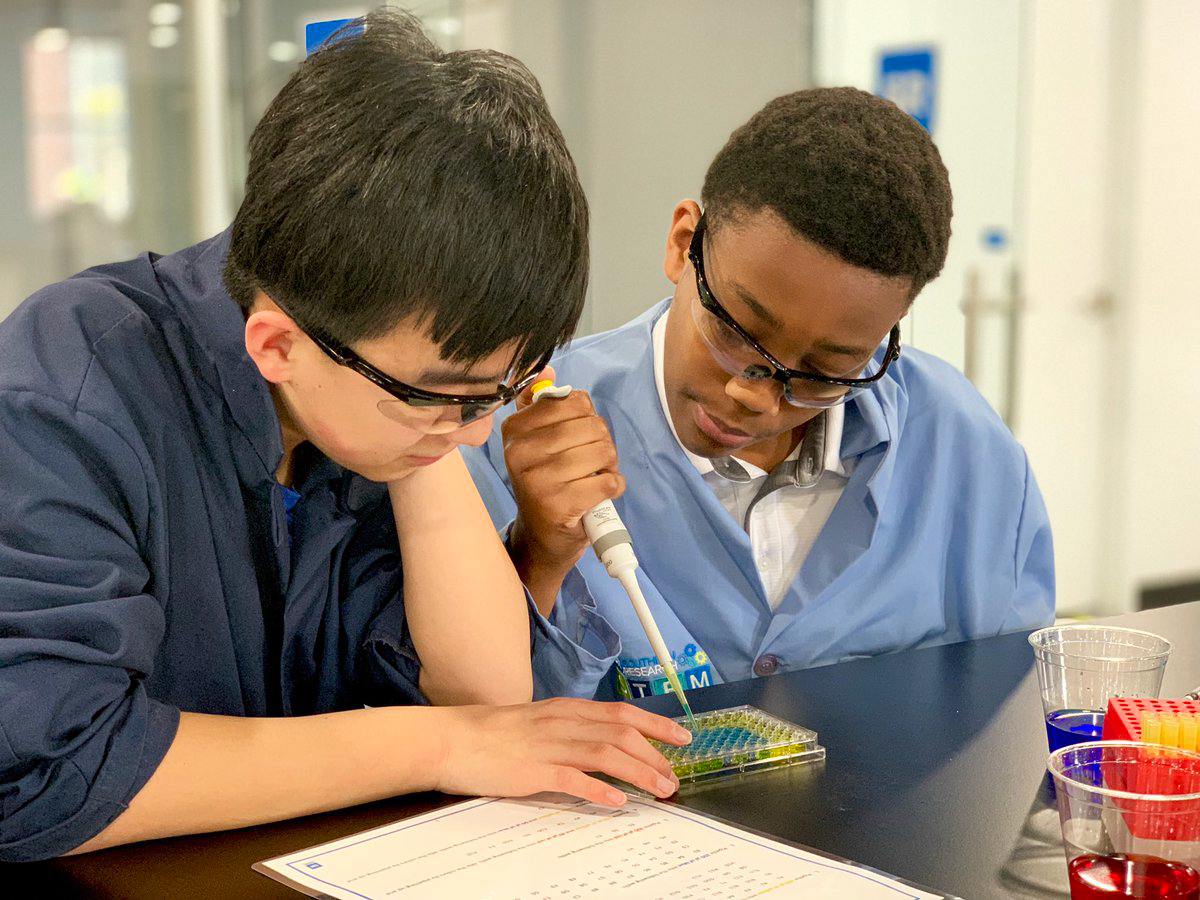
Students explore, experiment, and innovate through immersive STEM experiences designed to connect classroom concepts with real-world discoveries.
We’ve reached capacity for the fall semester! Join our waitlist below.
Available Experiences
Investigate and discover the exciting, interdisciplinary nature of STEM through hands-on field trip experiences that provide opportunities to explore and engage in critical thinking, problem-solving, and collaboration across an array of scientific concepts. Southern Research field trips expose students to various pathways that can lead to a career in STEM. Each field trip offered aligns with the Alabama Course of Study as well as the cutting-edge work conducted by our scientists.
Before submitting a request: Please review our “Preparing for My Visit” and FAQ sections for important information about reimbursement, booking eligibility, and how field trip requests are evaluated.
Breathing New Life into Asthma Treatment: Pharmacogenetics & Precision Medicine
What if your genes could influence how well your medicine works? In this hands-on experience, students explore how pharmacogenetics—the study of how genes affect a person’s response to drugs—plays a role in asthma treatment. Students investigate genetic variants that influence responses to albuterol, analyze DNA mutations using molecular models, and simulate how environmental triggers affect lung function. Students will also examine how precision medicine is changing the future of healthcare, one breath at a time.
Class Size: Limited to 32 students
Length: 5 hours; This field trip includes lunch
Infectious Diseases: How to Track and Diagnose Viral Outbreaks
What happens when a disease begins spreading through a population? In this interactive investigation, students will witness a live disease outbreak unfold, then work together to identify patient zero. Along the way, they’ll discover how the immune system fights infection and use biotechnology techniques like PCR and gel electrophoresis to investigate a simulated outbreak. Students will finish by stepping into the role of an epidemiologist, tracing the source of the outbreak through a hands-on transmission mapping activity.
Class Size: Limited to 32 students
Length: 5 hours; This field trip includes lunch
Pathways to Treatment: The Science of Drug Development
Step into the shoes of a pharmaceutical scientist! In this hands-on field trip, students explore the journey of a medication—from how it interacts with cells to how scientists design effective delivery methods. Blending biology, chemistry, and biomedical engineering, this experience offers a real-world look at how science transforms ideas into life-saving treatments.
Class Size: Limited to 32 students
Length: 5 hours; This field trip includes lunch
Disease Diagnostics: Using PCR to Diagnose Cystic Fibrosis
What if inherited changes in a single gene affected how your lungs, pancreas, and other organs function? Imagine discovering that just one tiny genetic variant could change how your lungs, pancreas, and other organs function. In this immersive genetics investigation, students become medical geneticists tasked with uncovering the cause of a patient’s symptoms.
Students will explore the genetics of cystic fibrosis, discovering how DNA is transcribed and translated into the proteins that keep our bodies functioning. Through hands-on activities, students will model the polymerase chain reaction (PCR) to understand how scientists amplify DNA and detect disease-causing genetic variants. Students will then analyze patient DNA using gel electrophoresis to determine whether a mutation in the CFTR gene is present. Finally, they will use their findings to build a family pedigree, tracing the inheritance of the variant and predicting which family members may have cystic fibrosis and which may be carriers.
Class Size: Limited to 32 students
Length: 5 hours; This field trip includes lunch
Beyond the Bitter Taste: Decoding Your DNA
Explore how your DNA influences your sense of taste through a hands-on investigation into the ability to taste PTC (phenylthiocarbamide). Use Punnett squares to predict dominant and recessive traits, then gather and analyze class data to explore phenotypic and genotypic patterns. Finally, step into the shoes of a molecular biologist as you extract DNA, amplify it using PCR, and visualize the results through gel electrophoresis to uncover the genetic code behind your unique taste experience.
Class Size: Limited to 32 students
Length: 5 hours; This field trip includes lunch
Intro to Catalyst: Precision Medicine in Action
Dive into the world of predictive and precision medicine as we explore polygenic risk scores, the impact of social determinants of health, and the complex challenges of modern healthcare. Then, take a closer look into the genomics of the neuroscience of opioid dependence, and why certain individuals may be at higher risk. Students will explore how genetic variation, individual experiences, and social determinants of health can contribute to a person’s risk of developing opioid use disorder.
Class Size: Limited to 32 students
Length: 5 hours; This field trip includes lunch
Antibiotic-Resistant Bacteria: Not Just a Phage!
Have you ever imagined a world where a mere sneeze could become a showdown? Where common infections gear up like superheroes? Welcome to the Antibiotic Apocalypse – a world in which antibiotics can no longer defeat common infections. A world where strep throat could again be fatal.
Students will explore how strains of bacteria become resistant to antibiotics through a series of hands-on activities. Students will conduct a simulation to illustrate how misused antibiotics can generate selection pressures for some bacteria to flourish. Students will then use biotechnology techniques, including PCR and gel electrophoresis, to investigate whether certain strains of bacteria have developed antibiotic resistance by amplifying the ampR gene.
Class Size: Limited to 32 students
Length: 5 hours; This field trip includes lunch
Breaking the Code: How Cells Become Cancerous
Uncover the foundations of cancer by exploring how changes at the cellular and genetic level can lead to disease. Through hands-on activities, investigate cell structure, mitosis, and how abnormal cell division and morphology contribute to cancer formation. Then, trace the role of genetic mutations—like those affecting p53, the “guardian of the genome”—and discover how these changes increase the risk of cancer development. This immersive experience connects cell biology to real-world medical science.
Class Size: Limited to 32 students
Length: 5 hours; This field trip includes lunch
Bitter Truth: A Taste of Genetics
Why can some people taste bitterness in certain foods while others can’t? In this hands-on field trip, students will explore how genes influence our sense of taste. They’ll test their ability to taste PTC using taste papers, investigate dominant and recessive traits, and make predictions using Punnett squares. Students will also examine their own cheek cells under a microscope and discover how genetic variation makes each of us unique.
Class Size: Limited to 32 students
Length: 3 hours; This field trip does not include lunch
Infectious Diseases: Epidemiology in Action
Students will explore how the immune system detects and responds to invading pathogens. They will model the difference between a primary and secondary immune response, investigate how infections spread through a simulated disease outbreak, and learn an essential biotechnology skill by practicing the use of micropipettes.
Class Size: Limited to 32 students
Length: 3 hours; This field trip does not include lunch
Breathing New Life into Asthma Treatment: The Power of Pharmacogenetics
In this hands-on experience, students explore the connection between genetics and asthma by learning how changes in DNA can lead to different responses to treatment. Through interactive modeling and real lab techniques, students discover how the respiratory system works, how asthma affects the airways, and why two people can take the same medicine but have different results. This field trip introduces the foundations of pharmacogenetics and shows how precision medicine can help doctors choose the right treatment for each patient.
Class Size: Limited to 32 students
Length: 3 hours; This field trip does not include lunch
Molecules in Medicine: Where Chemistry Meets Care
Step into the role of a pharmaceutical chemist! In this hands-on experience, students will explore how small molecular changes can dramatically impact how a drug works in the body. They’ll analyze patient symptoms, design a custom treatment, and test their medication in an interactive simulation that bridges chemistry and medicine in a fun and meaningful way.
Class Size: Limited to 32 students
Length: 5 hours; This field trip includes lunch
Thank you for choosing Southern Research as a field trip experience for you and your students. We are thrilled to meet your group, and we look forward to a fun-filled day of STEM! Please review the following information to help prepare you for a field trip at Southern Research.
For your safety, we require all visitors to wear proper laboratory clothing, which includes pants and closed-toe shoes. Individuals with long hair should have a way to secure it away from the face so as not to interfere with any experiment. All students will be provided with a lab coat, goggles, and gloves as needed. Our laboratory and makerspace is equipped with proper safety equipment. Please let us know if any visitor has any allergies or needs any special accommodations. No food, drink, or chewing gum is permitted in the laboratory.
For groups arriving by school bus: Please parallel park the bus along 9th Avenue South, in front of the main entrance into the Southern Research New Research Building. A Southern Research team member will meet you outside to escort you into the building.
For groups arriving by car or van: Please park in the visitor’s parking lot, located directly across the street from the main entrance. A Southern Research team member will meet you at the main entrance to escort you into the building.
We want your students to have the BEST day ever while visiting Southern Research. While in the lab, we encourage students to ask questions, collaborate with each other, and actively participate in class discussions. Please remind students that Southern Research is a place of business, so they must walk, not run, through public areas quietly. The usage of cell phones for taking photos while on the field trip is at the discretion of the teacher.
All students under the age of 19 visiting the STEM Education Outreach Center must have a parent or guardian sign our Student Visitor Agreement Form. This form includes a media release, which allows for students to be featured in Southern Research marketing, publications, and/or social media. We strongly encourage teachers and chaperones to take photos and videos with their own devices while in the STEM Education Outreach Center. If you share your photos and/or videos on social media, be sure to tag Southern Research STEM Outreach!
Southern Research provides reimbursement for eligible Alabama public schools to help offset the cost of one district school bus (up to $500) and up to one substitute teacher.
To receive reimbursement:
- Bring your students to your scheduled field trip.
- Have someone from your school’s finance department submit an itemized invoice and a completed Form W-9 to stem@southernresearch.org after your visit.
- Follow the reimbursement instructions provided by our team to ensure timely processing.
Reimbursement is limited to one field trip per school per school year unless otherwise approved in advance.
We provide field trip experiences for 6th – 12th grade students here at Southern Research. Unfortunately, we cannot host K-5 students at our facility due to safety concerns. But, we love engaging with eager, young future scientists and engineers! To see what we offer for K-5 students, check out our Elementary Outreach tab for more information.
Please fill out the request form and you will receive a confirmation email from our STEM team by August 31st. Please note this form is a request for that date and field trip experience, and it does not lock in your reservation until you receive official confirmation from our STEM team.
Our funding allows us to provide field trip opportunities to schools across the entire state of Alabama. To help us serve as many schools and students as possible, each school may participate in one field trip per school year.
Schools may submit requests for additional field trips. These requests will be considered based on availability, scheduling capacity, geographic reach, and our goal of serving schools across Alabama.
All Southern Research field trips are free for participating schools! Field trip opportunities are made possible through support from the State of Alabama.
For Alabama public schools, reimbursement support is available to help offset transportation and substitute teacher costs. Details about reimbursement eligibility and submission can be found below.
We offer reimbursement to cover the cost of up to one substitute teacher and one district school bus (up to $500) for Alabama public schools.
To request reimbursement, please have someone from your finance department send an itemized invoice and completed Form W-9 to stem@southernresearch.org no later than 60 days after your field trip. Detailed reimbursement instructions can be found here.
Field trip requests are not approved on a first-come, first-served basis. Requests are reviewed based on several factors, including program fit, scheduling, program capacity, geographic reach, and our goal of serving schools across the state of Alabama.
Fall semester field trip requests are now open.
We host field trips at Southern Research in our STEM Education Outreach Center, located at 2000 9th Avenue South, Birmingham, AL 35205.
Our lab can accommodate a minimum of 10 students and a maximum of 32 students.
Generally speaking, all field trips begin between 8:30 – 9:00 AM depending on travel time. Full-day field trips end between 1:45 – 2:15 PM and half-day field trips end between 11:30 AM – 12:00 PM. We understand bus restrictions and travel time can sometimes be an issue. Please let us know if you need to adjust your arrival and/or departure time, and we will try our best to accommodate your needs.
Each student must bring a signed copy of our Student Visitor Agreement form, which you receive in your confirmation email. You can also download a copy.
We provide lunch for all attendees (students, teachers, and chaperones) of full-day (5 hour) field trips. Prior to your visit, you will be asked to provide any dietary restrictions or allergies of your group so that we can meet the needs of your students and chaperones.
Yes, student groups can bring their own lunches, but there is no refrigeration or microwave usage available.
Southern Research has a collaboration space within the STEM Education Outreach Center where students, teachers, and chaperones may eat.
All students must wear pants and closed-toe shoes to comply with laboratory safety requirements.
Yes! We strongly encourage you to take photos and videos in the permitted areas, which include inside the STEM Education Outreach Center as well as by our Southern Research sign in front of our building.
In the event you must cancel your field trip, please contact us no later than 48 hours prior to your trip. Please contact stem@southernresearch.org to cancel your field trip, with the subject line: Field Trip Cancellation.
In the event of severe weather, our top priority is the safety of you and your students. Please let us know as soon as possible the need to cancel due to severe weather. We will do our best to reschedule your field trip, pending availability. Please contact stem@southernresearch.org to cancel your field trip, with the subject line: Field Trip Cancellation.
Yes; please see our Field Trip Course of Study Alignment for high school and middle school under Field Trip Experiences.
Our field trips are led by the experienced members of our STEM Education Outreach team, Dr. Kathryn Lanier, Mr. Shon Essex, Mrs. Molly Kuzmich, Ms. Kristen Bates, and our STEM Ambassadors.
Please see “Preparing for My Visit” for more detailed information. Have a question that is not answered here? Please contact our STEM Education Outreach team at stem@southernresearch.org.


Want to stay in
the loop?
Join our mailing list for the latest STEM opportunities, events, and updates!